Typing Games
Word Puzzle Typing Games for Spelling and Vocabulary
Build spelling skills and vocabulary through typing puzzles that test letter patterns, active recall, and quick keyboard execution on every challenge.
By ProTypingGames ·
You can improve your spelling, vocabulary, and keyboard confidence at the same time by playing word puzzle typing games that require you to actively retrieve letters rather than just copy text. Instead of staring at an existing paragraph, puzzle games force you to identify missing vowels, rearrange anagrams, and verify orthographic patterns before your fingers tap the keys.
Many traditional typing drills focus purely on transcription speed. In standard timed tests, you glance at a word stream, move your hands automatically, and chase raw output. That repetition builds physical fluency, but it lets your mind skip the deeper lexical processing that solidifies tricky spelling rules. Puzzle-based typing shifts your attention back to how words are constructed, helping you spot silent letters, diphthongs, and prefixes while reinforcing exact physical movements across the keyboard.
How puzzle typing trains your brain and fingers
When you copy text during a standard test, your eyes often stay several characters ahead of your keystrokes. Your visual system recognizes entire word shapes at once, which is helpful for sheer speed but easy to bypass if you want to master precise spelling. Word puzzles break that automatic reading habit.
Solving an anagram or deducing a hidden word requires active lexical retrieval. You have to search your internal vocabulary memory, select the matching sequence, and mentally organize the letters before you commit them to the screen. Once you solve the puzzle mentally, your fingers translate that sequence into motor patterns. This tight loop between mental problem-solving and immediate typing builds a stronger memory pathway than either passive reading or pure mechanical copying alone.
Puzzle games on ProTypingGames operate with distinct mechanics built around built-in word banks. It is helpful to know that games like Letter Hunt and Spell Quest draw entirely from curated internal lists rather than customizable study lists. Because they do not function as custom-word editors, you engage with unpredictable prompts that test your genuine vocabulary breadth rather than rote memorization of an assigned homework list.
Deduce missing letters in Word Guess
In Word Guess, you face a classic deduction challenge. The game presents a hidden target word obscured by blank spaces, and you input letter guesses to reveal its structure one piece at a time.
Every guess forces you to evaluate common English word structures. If your first input uncovers an initial consonant and an ending vowel, you immediately start testing likely consonant blends, vowel teams, or affixes that bridge the gap. Unlike open-ended typing where you react to complete prompts, every keystroke here is an intentional hypothesis.
Here is an example of how a round of Word Guess plays out in practice:
- Target word:
C H I M E R A(7 letters) - Clue display at start:
_ _ _ _ _ _ _ - Guess 1: You type
E. Result:_ _ _ _ E _ _ - Guess 2: You type
A. Result:_ _ _ _ E _ A - Guess 3: You type
R. Result:_ _ _ _ E R A - Guess 4: You type
M. Result:_ _ _ M E R A - Guess 5: You type
I. Result:_ _ I M E R A - Guess 6: You type
C. Result:C _ I M E R A - Guess 7: You type
H. Result:C H I M E R A(Solved)
When you guess letters individually, you pay close attention to spatial relationships on your keyboard. Spotting that an unknown letter sits between an I and an E makes you mentally scan your middle-row and top-row reaches, keeping your hands oriented as your brain tests possible words.
Reconstruct scrambled letter sequences
Anagram puzzles flip the challenge entirely. In Word Scramble, all the letters you need sit in plain view, but they appear in a jumbled order. Your objective is to unscramble the letters and type out the valid target word.
This format directly targets morphological and orthographic awareness. English contains rules about which letters can sit together. When you look at a scramble, your eyes quickly discard illegal clusters (such as Q directly followed by Z) and search for natural pairings like S H, T H, or I N G.
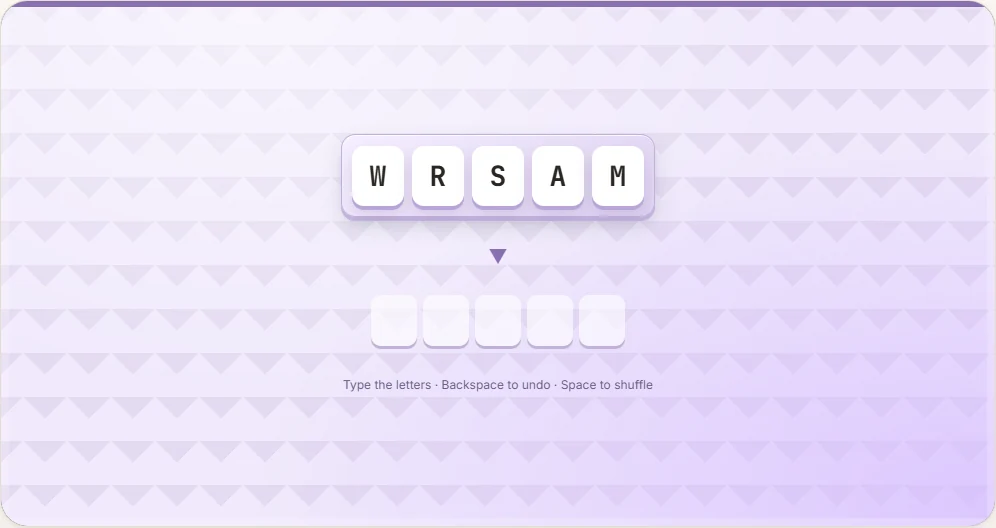
Consider these three practical scramble exercises that mirror the game experience:
Worked Example 1:
- Scrambled prompt:
P L A Y S I D - Analysis: Notice the
D,I,Scombination, which often forms a common prefix. IsolatingD I SleavesP L A Y. - Solution:
D I S P L A Y
Worked Example 2:
- Scrambled prompt:
N E T I B F E - Analysis: Look for common vowel-consonant roots. Grouping
B E N EleavesF I T. - Solution:
B E N E F I T
Worked Example 3:
- Scrambled prompt:
Q U E N A C T - Analysis: A
Qalmost always demands aU. That gives youA C Q U, pointing toward a root involving knowledge or familiarity. - Solution:
A C Q U A I N T(assuming the full eight-letter bankA C E I N Q T U)
Solving these scrambles demands complete word synthesis before your hands can move smoothly. Once you recognize the base pattern, typing the final solution reinforces the correct spelling sequence directly into your finger memory.
Spot target vocabulary with Letter Hunt
While some games ask you to assemble or deduce complete terms, Letter Hunt challenges you to identify specific characters and patterns from a broader display.
Games of this type sharpen your scanning efficiency and keyboard targeting. Instead of reading linearly from left to right as you would on a printed page, your gaze moves across a grid or field to spot the exact letters needed to fulfill the game prompt. Because Letter Hunt relies on internal dictionaries and does not offer a custom text box, you must adapt instantly to whatever vocabulary bank the system serves up.
This style of scanning trains your visual peripheral awareness. When typing difficult vocabulary, many mistakes happen because a typist loses track of upcoming tricky clusters like the double letters in accommodate or occurrence. Regularly scanning for specific target letters keeps your visual processing sharp and reduces hesitations during complex words.
Test definitions and spelling in Spell Quest
When you want an experience that targets spelling integrity alongside meaning, Spell Quest provides an engaging challenge. The game tasks you with producing accurate spellings under specific puzzle constraints.
Because Spell Quest operates strictly from built-in word pools, it provides an objective test of your active spelling vocabulary. You cannot load an easy list or bypass unfamiliar words. If the game demands a word with silent consonants or irregular vowel spellings, you must know the exact character sequence to move forward.
Here are three spelling patterns that regularly trip up typists, along with the precise character breakdown to keep in mind:
- Tricky double consonants:
C O M M I T T E E(two M’s, two T’s, two E’s). A typist who rushes often drops the secondTor forgets the final double vowel. - The deceptive silent letter:
S U B T L E(the silentBrests directly between the vowel and the dental consonant). - The
I EversusE Ivariation:F O R F E I T(an exception to the classic rhyme that catches many adult spellers off guard).
Navigating these words in an interactive game environment helps turn tricky mental exceptions into reliable motor habits. For more targeted strategies on building baseline accuracy across tricky vocabulary, review our guide to spelling word typing practice.
Keeping puzzle scores separate from speed metrics
As you jump between casual puzzle titles and standard typing tests, it is critical to understand that different game formats measure success differently. Each game or test on ProTypingGames maintains its own distinct scoring method, and you cannot directly convert a puzzle result into a standard Words Per Minute (WPM) figure.
Standard typing tests track your output using strict mathematical formulas based on character units:
- Raw WPM is calculated by taking your retained typed character units, dividing by 5, and dividing by the elapsed time in minutes.
- Net WPM takes your correctly matched character units, divides by 5, and divides by the elapsed time in minutes.
- Accuracy represents your successful attempts divided by all scored attempts, multiplied by 100 and rounded.
Because fixing an error does not erase that recorded attempt from your total, every misstep is accounted for. Furthermore, if you correct a mistake by deleting it, those corrected-but-deleted keystrokes do not count toward your retained raw character total. Backspace works across spaces within the active screen on every test, but you cannot use it to travel back to previous, completed pages.
Puzzle games do not follow this formulaic WPM framework. Word Guess tracks your deduction accuracy and remaining attempts, Word Scramble scores your solved anagrams, and games like Word Rain evaluate your ability to clear falling terms before they reach the bottom of the screen. Celebrate each game’s score on its own terms rather than trying to map it against your timed paragraph metrics.
Integrate puzzle games into daily practice
Word puzzles are most effective when paired intentionally with traditional keyboard drills. You do not need to overhaul your entire training routine to see noticeable improvements in your spelling and vocabulary retention.
Here is a balanced twenty-minute practice schedule you can run several times a week:
- Five minutes of warm-up: Start with an open, stress-free format like Zen Type, which features no countdown timer and no lives. Focus entirely on clean, rhythmic key strikes.
- Seven minutes of puzzle deduction: Play several rounds of Word Scramble or Word Guess. Pay close attention to how quickly your eyes detect prefixes, suffixes, and common letter blends.
- Five minutes of targeted vocabulary: Switch to Spell Quest or Letter Hunt to test your recognition of words drawn from the platform’s internal dictionaries.
- Three minutes of standard assessment: Finish with a timed test or a three-minute Data Entry test. Check your net WPM and accuracy percentage to see how clearly your fingers translate mental spelling into raw keyboard precision.
Open Word Scramble right now, solve your first five anagrams without looking down at your keyboard, and pay attention to how your fingers group the letters.
Put it into practice
The fastest way to improve is to play. Jump into a free typing game and try it now.
Play free typing games